We often talk about “Canadian health care” as if it were one system. This infographic breaks down who pays for health care and who runs it, then examines three challenges this system faces.
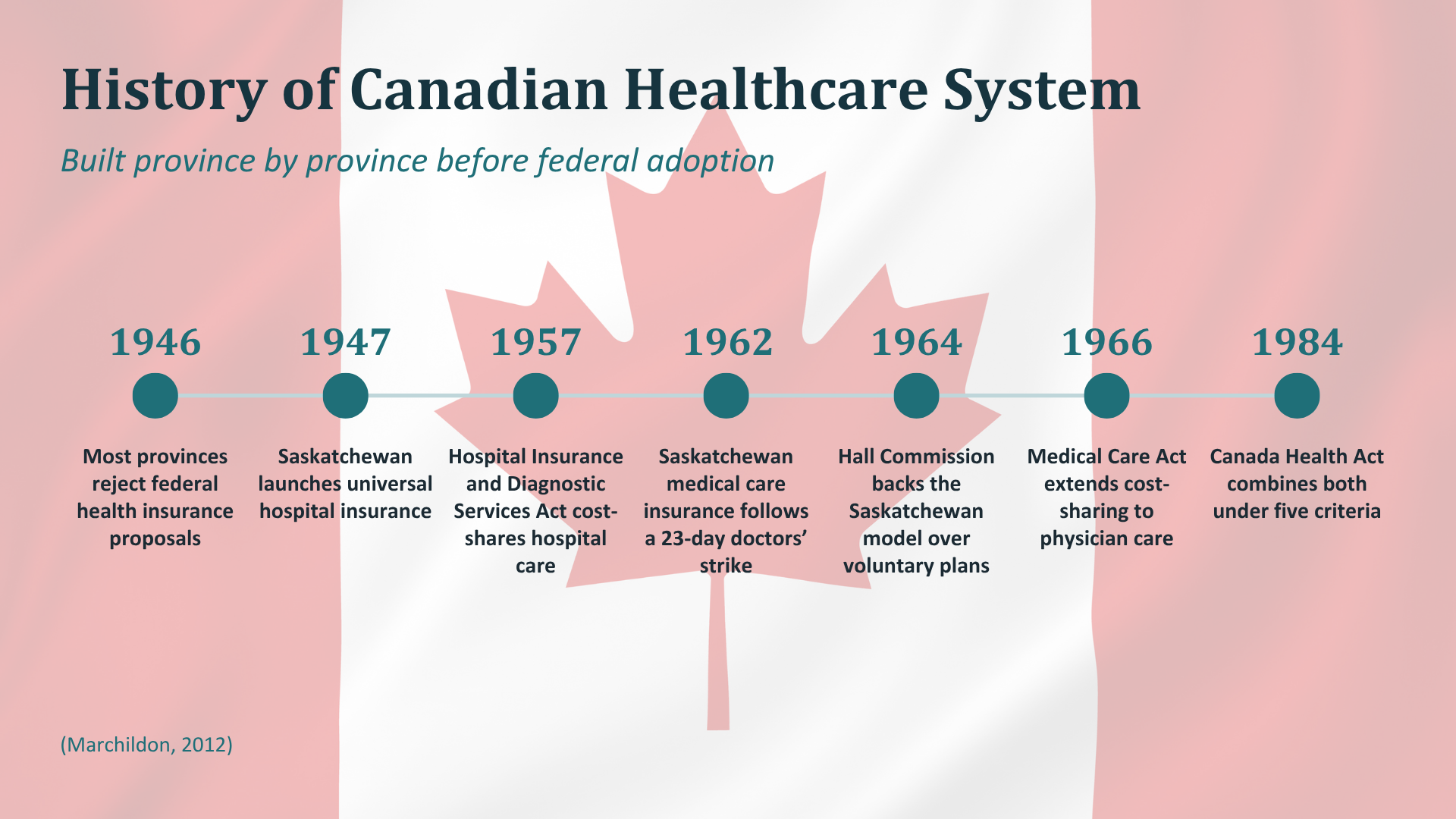
Under the constitution, health care falls mainly to the provinces. The Medicare we know today grew from provincial experiments rather than a single national plan. Saskatchewan’s compulsory, publicly funded model became the national template. Meanwhile, voluntary, multi-payer alternatives such as Alberta’s subsidized private plans were rejected (Marchildon, 2012).
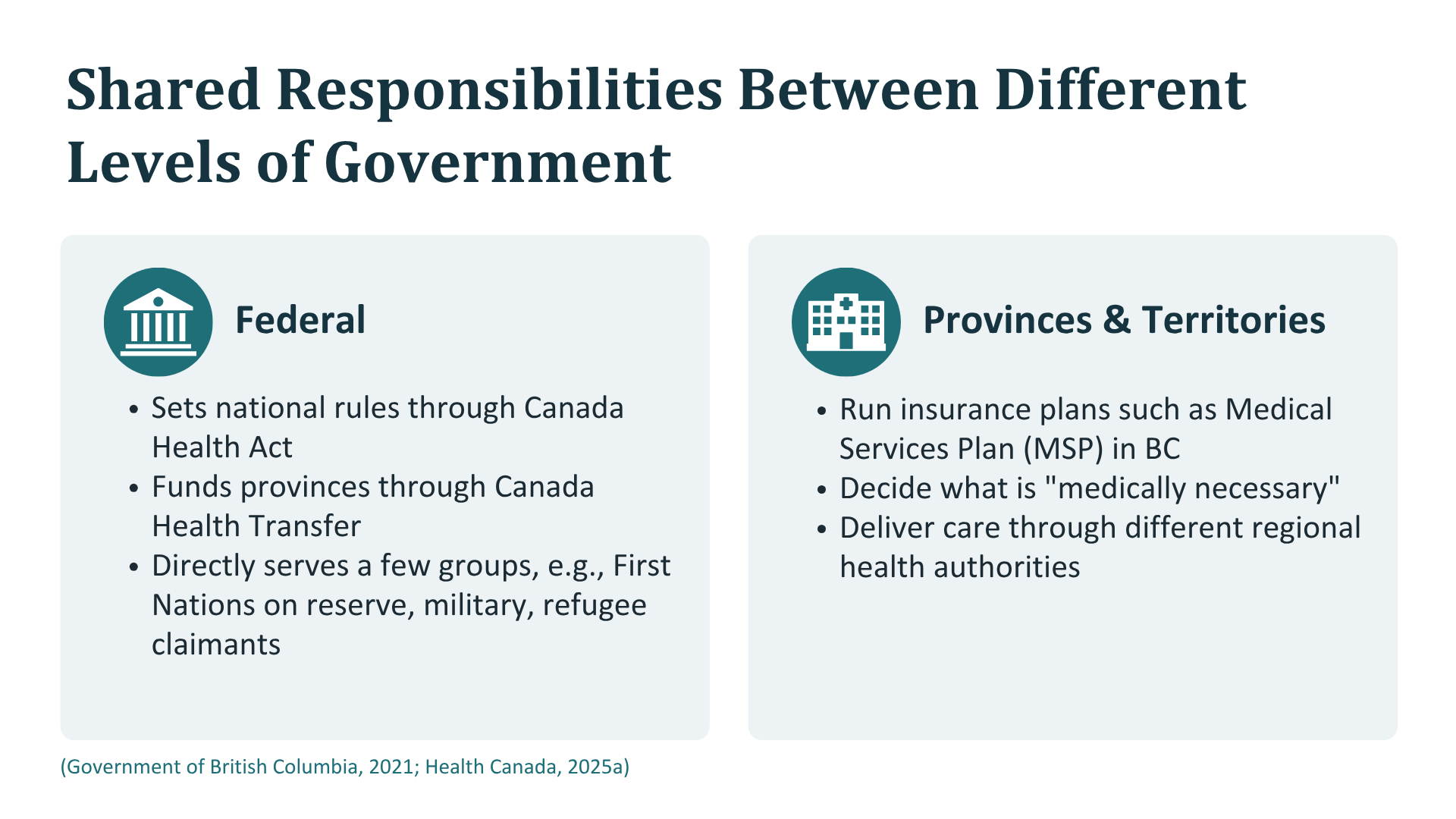
Beyond the roles shown above, the federal government regulates drugs and supports public health through health promotion programs, disease monitoring and prevention, and health research. On the other hand, the provinces and territories regulate health professions (Health Canada, 2025a). Because each province designs its own plan, public health coverage and protocol standards varies across the country (Canadian Medical Association, n.d.).
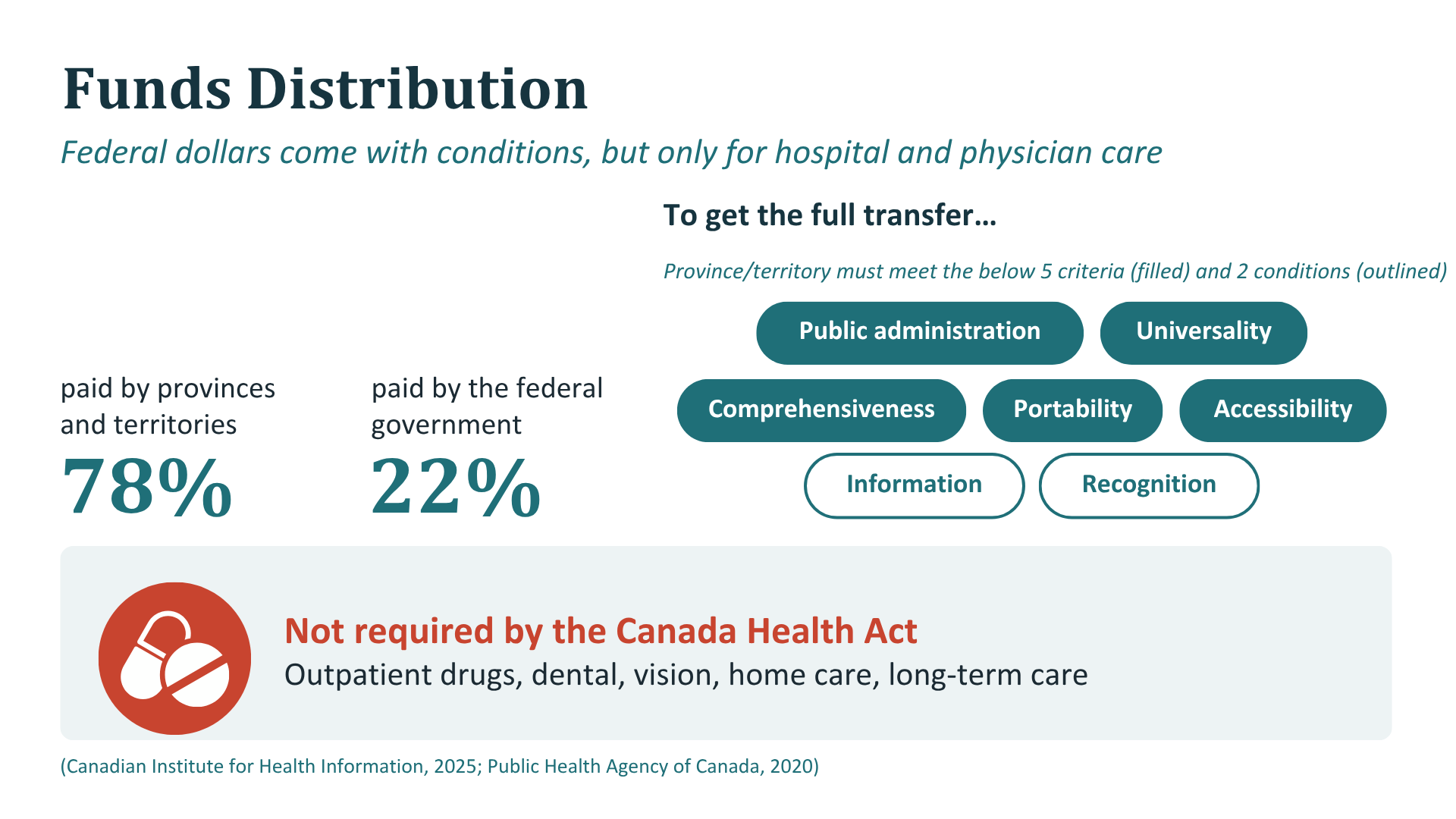
Federal funding also requires provinces to ban extra-billing and user charges for insured services (Public Health Agency of Canada, 2020). Outpatient drug coverage therefore differs by province, producing unequal access (Statistics Canada, 2022).A patient with chronic obstructive pulmonary disease, for example, may be discharged with inhaler prescriptions they cannot afford.
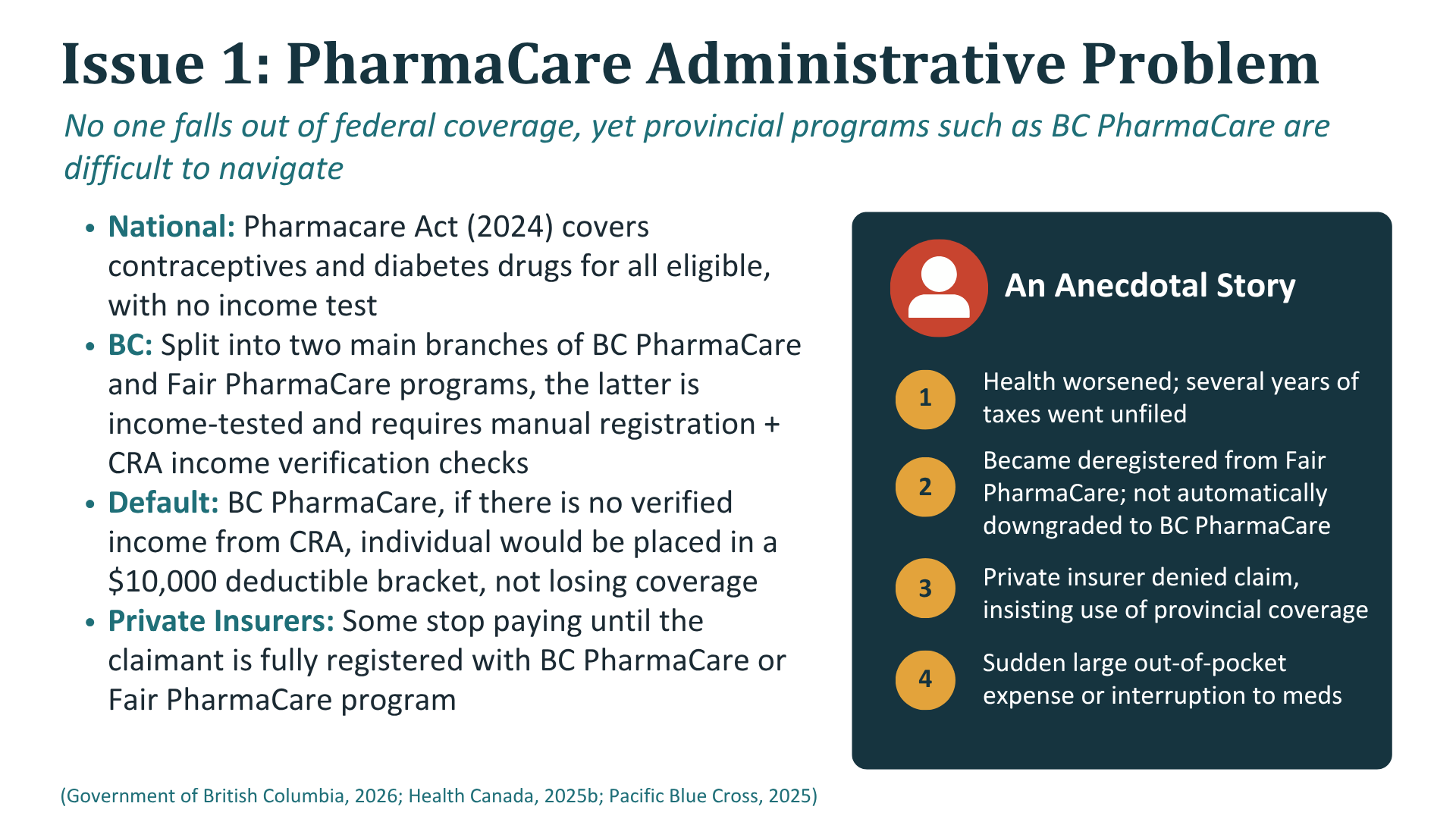
National pharmacare is delivered through bilateral agreements; as of January 2026, only Manitoba, British Columbia, Prince Edward Island, and Yukon had signed (Health Canada, 2026).
In this anecdote, a patient with a chronic health condition was partly deregistered from Fair PharmaCare instead of being moved to the default deductible. The private insurer then denied the drug claim until the patient becomes fully registered. Middle-income families who fall behind on adminsitrative tasks are the most exposed to this gap, and an income-tested plan revives the opt-in problem that Medicare’s founders rejected (Marchildon, 2012).
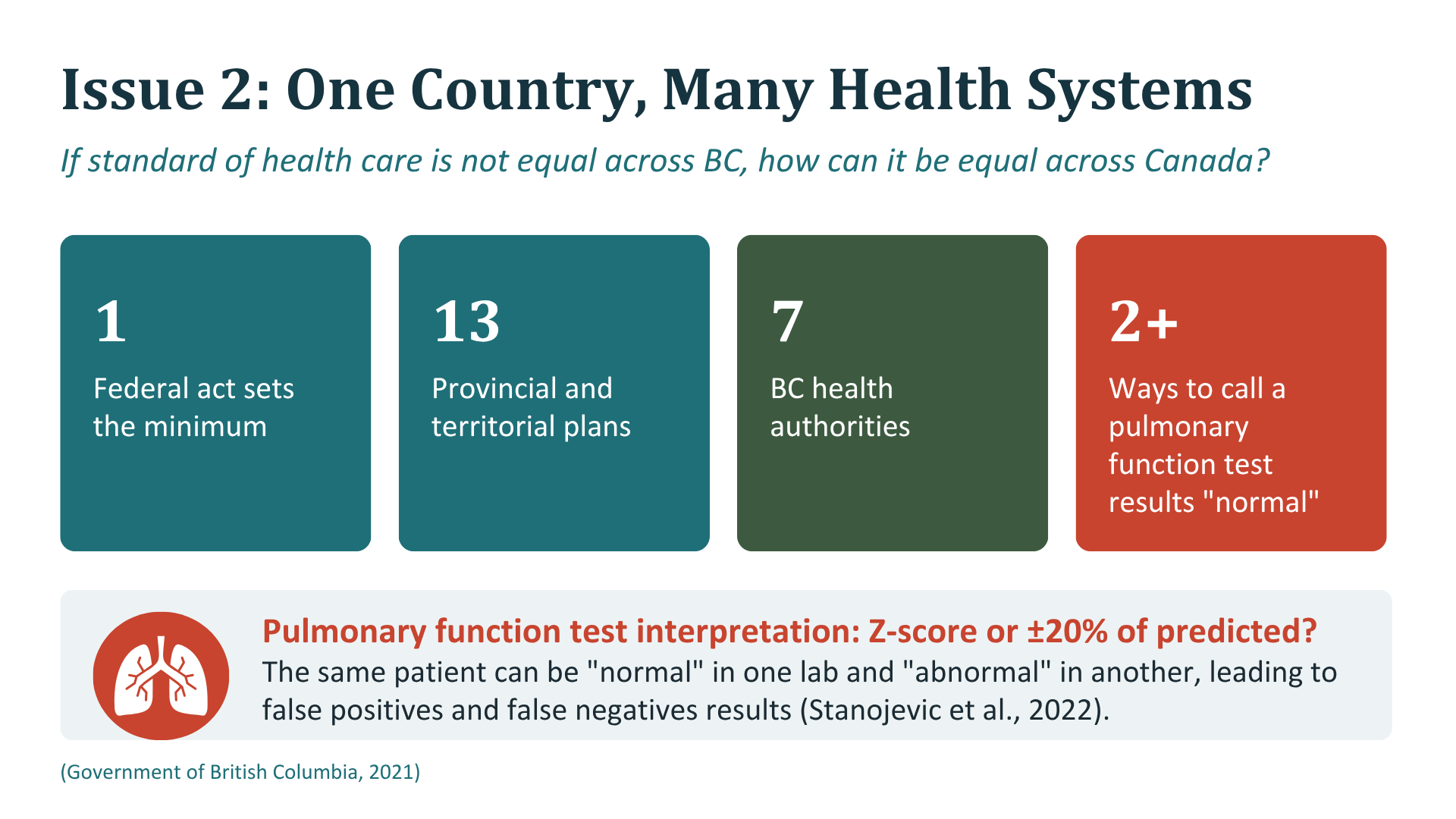
BC’s seven authorities are five regional health authorities, the Provincial Health Services Authority, and the First Nations Health Authority, and their clinical protocols can differ. Shared clinical standards, not only shared funding rules, would make care more consistent across jurisdictions.
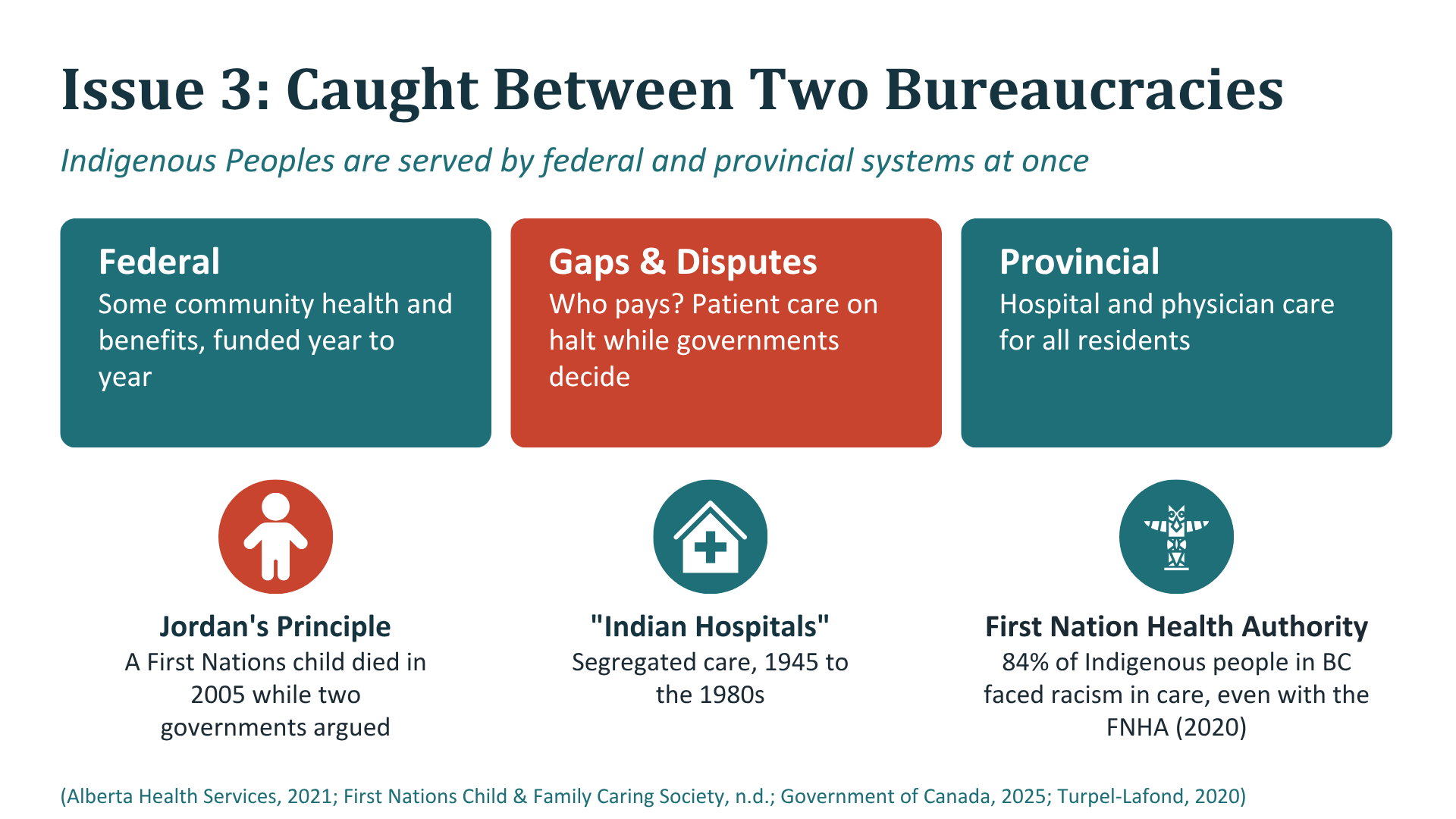
Jordan’s Principle, named for Jordan River Anderson, now requires that First Nations children receive services first, with governments settling payment afterward (First Nations Child & Family Caring Society, n.d.).
In BC, the First Nations Health Authority took over federal First Nations health programs in 2013 (First Nations Health Authority, n.d.), but hospital care remains provincial, and the In Plain Sight review found widespread Indigenous-specific racism in that system (Turpel-Lafond, 2020).
References
Alberta Health Services. (2021). Indigenous wellness core – Indian hospitals [Video]. YouTube. https://www.youtube.com/watch?v=5o9ubDDmF98
Canadian Institute for Health Information. (2025, November 27). NHEX trends – Infographics. https://www.cihi.ca/en/national-health-expenditure-trends/nhex-trends-infographics
Canadian Medical Association. (n.d.). Understanding public and private health care. https://www.cma.ca/our-focus/public-and-private-health-care/understanding-public-and-private-health-care
First Nations Child & Family Caring Society. (n.d.). Jordan’s Principle. https://fncaringsociety.com/jordans-principle
First Nations Health Authority. (n.d.). About us [Fact sheet]. https://www.fnha.ca
Government of British Columbia. (2021). Health authorities. https://www2.gov.bc.ca/gov/content/health/about-bc-s-health-care-system/partners/health-authorities
Government of British Columbia. (2026, October 8). Fair PharmaCare plan. https://www2.gov.bc.ca/gov/content/health/health-drug-coverage/pharmacare-for-bc-residents/who-we-cover/fair-pharmacare-plan
Government of Canada. (2025, August 6). About Indigenous health care. Indigenous Services Canada. https://www.sac-isc.gc.ca/eng/1626810177053/1626810219482
Health Canada. (2025a, June 25). Canada’s health care system. https://www.canada.ca/en/health-canada/services/canada-health-care-system.html
Health Canada. (2025b, March 6). Government of Canada signs pharmacare agreement with British Columbia to improve universal access to free medications [News release]. https://www.canada.ca/en/health-canada/news/2025/03/government-of-canada-signs-pharmacare-agreement-with-british-columbia-to-improve-universal-access-to-free-medications.html
Health Canada. (2026, January 26). National pharmacare bilateral agreements. https://www.canada.ca/en/health-canada/corporate/transparency/health-agreements/national-pharmacare-bilateral-agreements.html
Marchildon, G. P. (2012). Canadian Medicare: Why history matters. In G. P. Marchildon (Ed.), Making Medicare: New perspectives on the history of Medicare in Canada (pp. 3–18). University of Toronto Press.
Pacific Blue Cross. (2025, December 9). Pacific Blue Cross drug coverage explained. https://pac.bluecross.ca/advicecentre/story/pacific-blue-cross-drug-coverage-explained/
Public Health Agency of Canada. (2020, February 24). Infographic: Canada Health Act. https://www.canada.ca/en/public-health/services/publications/science-research-data/canada-health-act-infographic.html
Stanojevic, S., Kaminsky, D. A., Miller, M. R., Thompson, B., Aliverti, A., Barjaktarevic, I., Cooper, B. G., Culver, B., Derom, E., Hall, G. L., Hallstrand, T. S., Leuppi, J. D., MacIntyre, N., McCormack, M., Rosenfeld, M., & Swenson, E. R. (2022). ERS/ATS technical standard on interpretive strategies for routine lung function tests. European Respiratory Journal, 60(1), Article 2101499. https://doi.org/10.1183/13993003.01499-2021
Statistics Canada. (2022, November 2). Study: Inequities in pharmaceutical access and use. The Daily. https://www150.statcan.gc.ca/n1/daily-quotidien/221102/dq221102a-eng.htm
Turpel-Lafond, M. E. (2020). In plain sight: Addressing Indigenous-specific racism and discrimination in B.C. health care. Government of British Columbia. https://engage.gov.bc.ca/app/uploads/sites/613/2020/11/In-Plain-Sight-Full-Report-2020.pdf
Images used are sourced from Canva Pro’s stock image library and are for illustration only. Persons appearing in photographs shown are models.